Faculty and Staff

Environmental Law Collaborative Held in Colorado Springs

Posted
August 8, 2021
Image
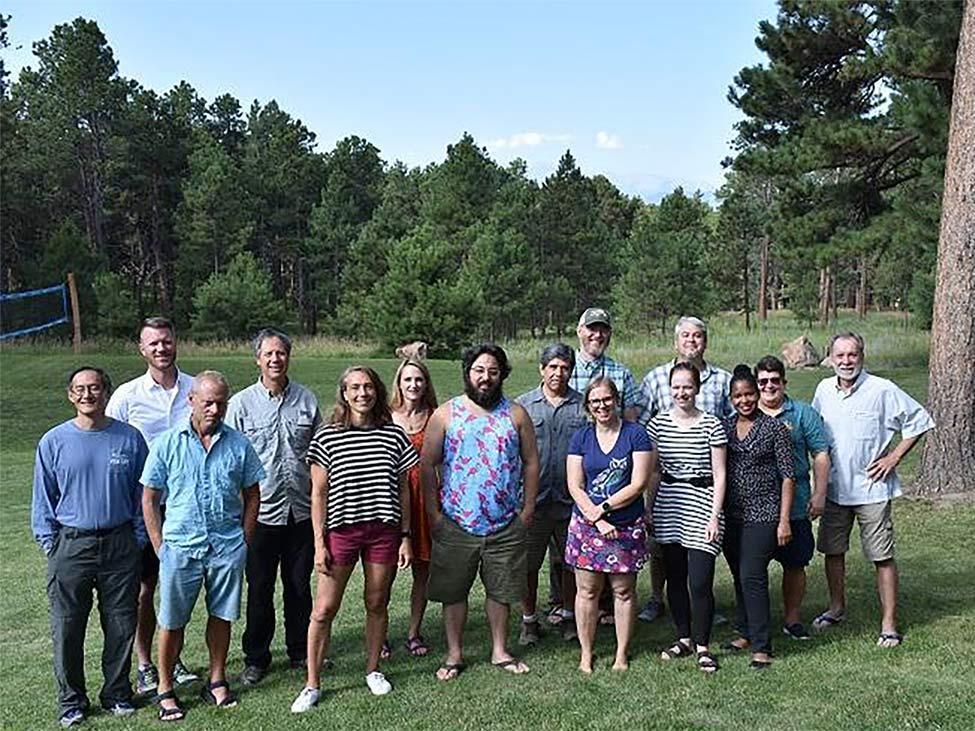
Professors Josh Galperin and Katrina Fischer Kuh are pictured, as well as a former Haub Visiting Scholar (Cliff Villa, Professor, University of New Mexico School of Law); James Salzman (Donald Bren Distinguished Professor of Environmental Law at UCLA, who delivered the Gilbert and Sarah Kerlin Lecture on Environmental Law at Haub Law in 2010); and Jessica Owley (Professor and Faculty Director at the University of Miami School of Law, previously an Assistant Professor at Haub Law).

The fifth meeting of the Environmental Law Collaborative took place in Colorado Springs in July. During the conference, environmental law scholars from around the country met to discuss "Facing the Worst Climate Case: The Role of Law." The Environmental Law Collaborative (ELC) seeks to foster progress toward an adaptive, conscious, and equitable governance of actions that impact local and global ecologies by engaging the contemporary discourse. The ELC facilitates dialogue among thought leaders on sustainable policy priorities, practical implementation strategies, assessment mechanisms, and cooperative analysis of science, economics, and ethics.

The Elisabeth Haub School of Law at Pace University was a co-sponsor of the fifth meeting of the ELC. Attending the recent ELC meeting from Haub Law were Professors Katrina Fischer Kuh and Josh Galperin. Professor Kuh is a board member of the ELC.

More from Pace

In the Media

Law Professor Bennett Gershman provides expert legal analysis to amNewYork on the distinction between New York City’s corporation counsel and chief counsel. Gershman explains that while the Law Department represents the city in litigation, the chief counsel serves as the mayor’s personal legal adviser, operating under attorney-client privilege on sensitive policy and legal matters— and New York Metropolitan Magazine has the story.

In the Media

In her recent op-ed published in the Albany Times Union, Pace Haub Law Professor Bridget J. Crawford examines a new federal tax rule that would allow tipped workers to claim a deduction—unless their tips come from what the Treasury Department defines as “pornographic activity.” Professor Crawford argues that this exclusion is not a question of morality, but of labor and tax fairness, warning that it disproportionately harms the modern digital workforce, especially women who earn income through subscription-based platforms. She notes that creators on sites like OnlyFans and Fansly are already taxed as independent contractors and receive 1099s like other freelancers, raising a critical question: why should one group of tipped workers be denied a benefit available to everyone else? “Tax policy should meet women where they actually work, not exclude them from deductions,” writes Professor Crawford. “The IRS’s job is to review income, not to judge women’s bodies or the way they earn a living. Women working in digital creator spaces deserve the same neutrality, fairness and access to deductions that the tax code offers other workers.”

In the Media

The Pace Environmental Litigation Clinic is featured in a recent Sierra Magazine article examining the successful effort to protect the 1011 2nd Avenue Forest, one of the last remaining waterfront forests in Troy, New York. In the case, the Clinic provided pro bono representation challenging the City of Troy’s environmental review and rezoning decisions, arguing that the City improperly issued a negative declaration under New York’s State Environmental Quality Review Act (SEQRA) and failed to adequately assess potential environmental and cultural impacts of the proposed development. As Managing Attorney Todd Ommen notes in the piece, the case reflected the Clinic’s core mission: representing environmental groups in matters where legal advocacy can play a critical role in protecting the natural environment.