Image
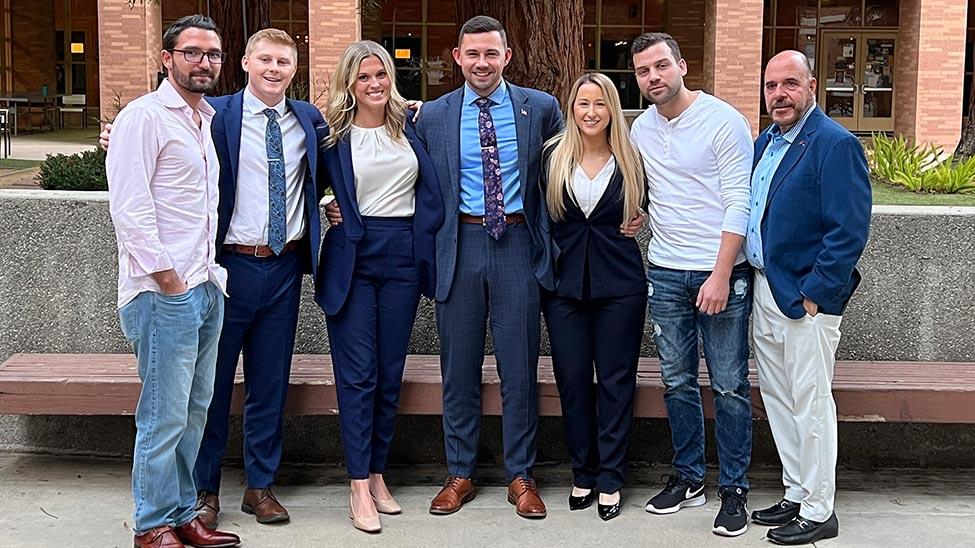
Students from the Elisabeth Haub School of Law at Pace University’s Trial Advocacy Team were honored with an invitation to compete in the Tournament of Champions Competition hosted by UCLA School of Law on October 29-31. The Haub Law team consisted of Kathryn Facelle (3L), Michael McNally (3L), Kimberly Abrahall (2L), and Liam Rattigan (2L) and was coached by alumni AJ Muller ’15 and Mike Luterzo ’20.
The annual exclusive competition only extends invitations to the top 16 trial advocacy institutions in the country. At the competition, the nation’s finest law students showcase their multifaceted talents by competing in teams of four with each team trying both sides of a civil case—twice as plaintiffs and twice as defendants. Participants also receive intensive, one-on-one coaching from top-tier professionals in law school trial advocacy programs.
"It was a true honor and privilege to be invited to the Tournament of Champions mock trial competition-- the most elite competition in the nation. Invitations are based solely on objective performance rankings in the preeminent national competitions,” said Professor Louis V. Fasulo, Director of Moot Court and Advocacy Programs. “Our students' success in the American Association of Justice competition over the last two years resulted in Haub Law’s first ever invitation to this exclusive tournament.”
Haub Law Adjunct Professor and alum AJ Muller has generously devoted his time as a trial coach for Haub Law since 2016. “This invitation marks yet another stride in our Advocacy Program's ascent into the national stage,” said Muller. “Our students' performance at the Tournament demonstrated our program's ability to produce the caliber of advocates needed to be a force on the national stage. I look forward to Advocacy Programs continued success to gain continuing entry into this elite Tournament.” Muller is also a Senior Associate at Trivella & Forte LLP. The Advocacy Team’s second coach, alum Mike Luterzo is an Assistant District Attorney with the Bronx County District Attorney’s Office. Luterzo started volunteering alongside Muller last year and together-- under the leadership of Professor Fasulo--they have fostered numerous successful advocacy teams, serving as mentors and coaches for many Haub Law students.

As the Pace Women’s Justice Center marks 35 years of advocacy, Executive Director Cindy Kanusher, JD, examines the legal obstacles facing survivors, the shortcomings of the justice system, and what it takes to help thousands of people find a path forward.

Professor Emily Gold Waldman has been awarded the 2026 Goettel Prize for Faculty Scholarship.

Haub Law launches the Environmental Law Fifty Fund to support innovative research, scholarship, and collaboration among junior environmental law scholars.